The Largest Open-Source AI Model
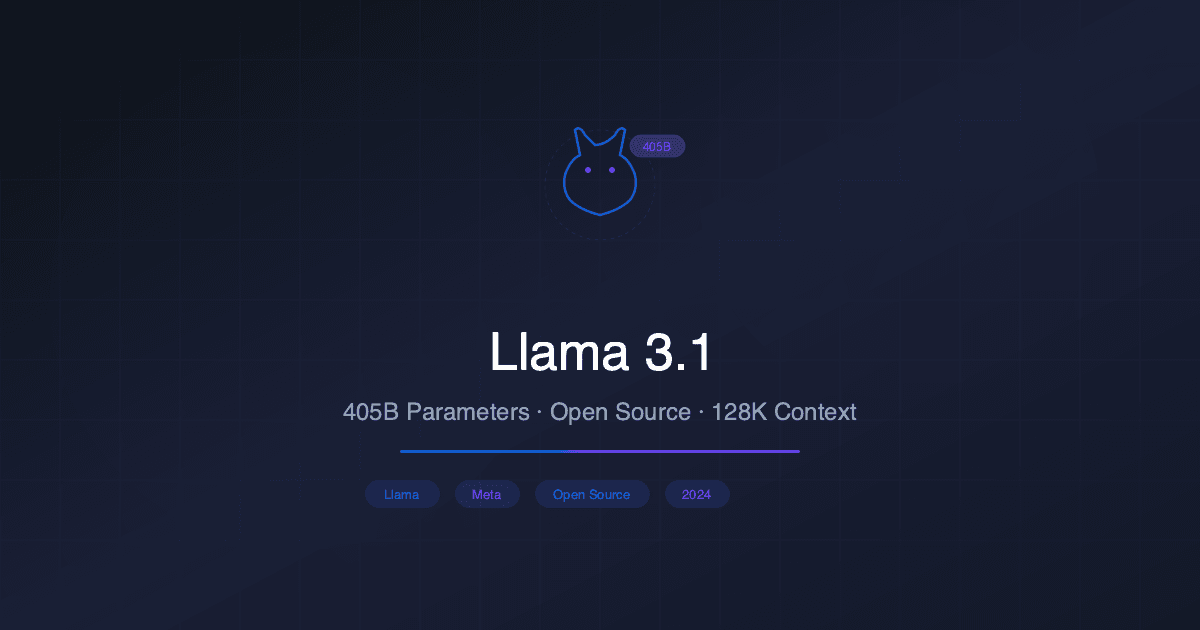
On July 23, 2024, Meta released Llama 3.1—including the 405B parameter variant, the largest open-source language model ever released. This wasn't just a size record; Llama 3.1 405B matched GPT-4o and Claude 3.5 Sonnet on key benchmarks, proving that open-source AI can compete at the frontier.
The release fundamentally changed the AI landscape: for the first time, any organization could run a model competitive with the best proprietary systems, on their own hardware, with full control over the code and weights.
Model Family
Llama 3.1 ships in three sizes:
| Model | Parameters | Context | MMLU | HumanEval | MATH |
|---|---|---|---|---|---|
| Llama 3.1 8B | 8B | 128K | 73.0 | 72.6 | 51.9 |
| Llama 3.1 70B | 70B | 128K | 86.0 | 80.5 | 68.0 |
| Llama 3.1 405B | 405B | 128K | 88.6 | 89.0 | 73.8 |
| GPT-4o | Unknown | 128K | 87.2 | 90.2 | 76.6 |
| Claude 3.5 Sonnet | Unknown | 200K | 88.7 | 92.0 | 71.1 |
The 405B model is within striking distance of the best proprietary models—and in some benchmarks, it wins.
128K Context Window
All three models support 128K token context—a massive improvement over Llama 3's 8K limit:
1# Llama 3.1 can process entire codebases
2# 128K tokens ≈ 96,000 words ≈ 300+ pages
3
4# Example: Load an entire project for analysis
5with open('project_files.txt') as f:
6    codebase = f.read()  # Up to ~300 pages of code
7
8response = model.generate(
9    f"Analyze this codebase and identify security vulnerabilities:\n{codebase}"
10)
This enables use cases that were previously impossible with open-source models:
- Full codebase analysis: Load entire repos for review
- Document processing: Analyze long legal/medical documents
- Conversation history: Maintain context across extensive dialogues
- Multi-document QA: Answer questions across dozens of documents
Training Details
Meta published extensive training details:
| Aspect | Detail |
|---|---|
| Training tokens | 15.6 trillion |
| Training compute | 30.84 million GPU-hours |
| Hardware | 16,384 NVIDIA H100 GPUs |
| Training time | ~54 days |
| Cost estimate | ~$60-100 million |
| Languages | 8 languages (incl. English, German, French, Hindi) |
| Data | Web crawl, code, books, papers (filtered) |
The training pipeline includes several notable techniques:
- Grouped Query Attention (GQA): Reduces memory usage during inference
- SFT + RLHF + DPO: Multi-stage alignment process
- Tool use training: Model can use search, code interpreter, math tools
- Safety training: Red-teaming and automated safety testing
Running Llama 3.1 Locally
1# 8B model — runs on consumer hardware
2ollama run llama3.1:8b  # Needs ~8 GB RAM
3
4# 70B model — needs a beefy workstation
5ollama run llama3.1:70b  # Needs ~48 GB RAM
6
7# 405B model — needs serious hardware
8# Full precision: ~810 GB (10x A100 80GB)
9# 4-bit quantized: ~200 GB (3x A100 80GB)
10vllm serve meta-llama/Meta-Llama-3.1-405B-Instruct \
11    --tensor-parallel-size 8 \
12    --quantization awq
Hardware requirements comparison:
| Model | Precision | VRAM | Min Hardware |
|---|---|---|---|
| 8B | FP16 | 16 GB | RTX 4090 |
| 8B | Q4 | 5 GB | RTX 3060 |
| 70B | FP16 | 140 GB | 2× A100 80GB |
| 70B | Q4 | 40 GB | RTX 4090 + CPU offload |
| 405B | FP16 | 810 GB | 10× A100 80GB |
| 405B | Q4 | 200 GB | 3× A100 80GB |
The Community License
Llama 3.1 uses a custom license that's more permissive than previous versions:
- Commercial use: Allowed for companies under 700M monthly active users
- Modification: Full rights to modify and create derivative works
- Distribution: Can redistribute modified versions
- Attribution: Must include Meta's attribution notice
- Large companies: Need special license from Meta
This license enables:
- Startups building products on Llama
- Enterprises running models on-premise for data privacy
- Researchers fine-tuning for specialized domains
- Cloud providers offering Llama-as-a-service
Impact on the AI Ecosystem
Llama 3.1's release triggered several industry shifts:
1. Commoditization of intelligence: When a free model matches GPT-4o, the value shifts from model capability to application and integration.
2. Privacy-first AI: Organizations handling sensitive data (healthcare, finance, government) can now use frontier-quality AI without sending data to third parties.
3. Fine-tuning ecosystem: Companies like Together AI, Anyscale, and Modal offer fine-tuning services, creating specialized versions for medical, legal, and technical domains.
4. Competitive pressure: OpenAI and Anthropic face pricing pressure—why pay premium API prices when a comparable model is free?
5. Geopolitical implications: Open-source models are available globally, bypassing any potential export restrictions on AI technology.
Llama's Ecosystem
| Tool | Purpose |
|---|---|
| Ollama | Easy local deployment |
| vLLM | High-performance inference server |
| llama.cpp | CPU/GPU inference with quantization |
| LangChain/LlamaIndex | Application frameworks |
| Hugging Face | Model hosting and community |
| Together AI | Cloud inference + fine-tuning |
What This Means for Developers
Llama 3.1 405B proves that open-source AI has reached parity with proprietary models. For developers, this means:
- No vendor lock-in: Build on open-source, switch providers freely
- Cost control: Self-host for predictable pricing
- Customization: Fine-tune for your specific use case
- Data privacy: Keep all data on your infrastructure
- Future-proof: Active community ensures continuous improvement
The era of "you need OpenAI for good AI" is over. Open-source is competitive, and getting better fast.
Sources: Meta AI Blog, Llama 3.1 Model Card, Hugging Face Llama