A New Benchmark for AI Intelligence
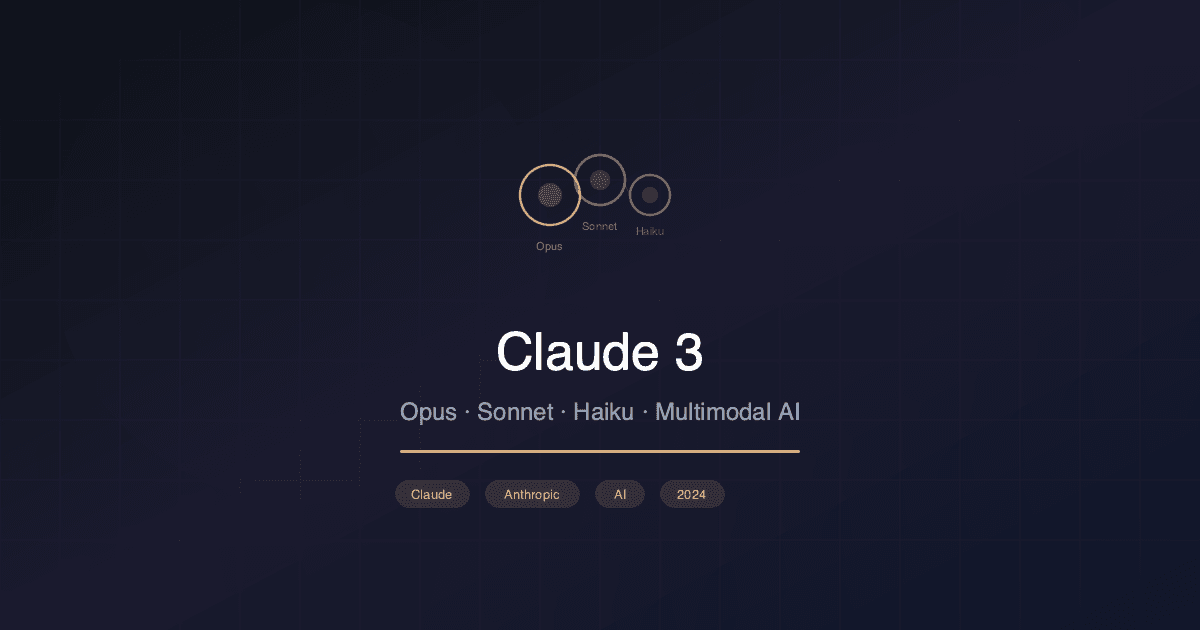
On March 4, 2024, Anthropic launched the Claude 3 model family—Opus, Sonnet, and Haiku—setting new benchmarks in AI reasoning, multilingual understanding, and visual analysis. Claude 3 Opus outperformed GPT-4 and Gemini Ultra on multiple benchmarks while maintaining Anthropic's focus on safety and helpfulness.
Model Lineup and Specifications
| Metric | Claude 3 Opus | Claude 3 Sonnet | Claude 3 Haiku |
|---|---|---|---|
| Intelligence | Highest | High | Fast & capable |
| Speed | Moderate | Fast | Fastest |
| Context Window | 200K tokens | 200K tokens | 200K tokens |
| Input Cost | $15/M tokens | $3/M tokens | $0.25/M tokens |
| Output Cost | $75/M tokens | $15/M tokens | $1.25/M tokens |
| Vision | ✅ | ✅ | ✅ |
| Multilingual | 95+ languages | 95+ languages | 95+ languages |
The 200K token context window across all models was significant—enough to analyze entire codebases, legal documents, or research papers in a single prompt.
Benchmark Performance
| Benchmark | Claude 3 Opus | GPT-4 | Gemini Ultra | Description |
|---|---|---|---|---|
| MMLU | 86.8% | 86.4% | 83.7% | General knowledge |
| GPQA | 50.4% | 35.7% | N/A | Graduate-level science |
| HumanEval | 84.9% | 67.0% | 74.4% | Code generation |
| GSM8K | 95.0% | 92.0% | 94.4% | Math reasoning |
| MATH | 60.1% | 52.9% | 53.2% | Competition math |
API Usage and Multimodal Capabilities
1import anthropic
2
3client = anthropic.Anthropic()
4
5# Text conversation
6message = client.messages.create(
7    model="claude-3-opus-20240229",
8    max_tokens=4096,
9    messages=[{
10        "role": "user",
11        "content": "Explain the difference between Server Components "
12                   "and Client Components in Next.js with examples"
13    }]
14)
15print(message.content[0].text)
16
17# Vision - analyzing images
18import base64
19
20with open("architecture-diagram.png", "rb") as f:
21    image_data = base64.standard_b64encode(f.read()).decode("utf-8")
22
23message = client.messages.create(
24    model="claude-3-opus-20240229",
25    max_tokens=4096,
26    messages=[{
27        "role": "user",
28        "content": [
29            {
30                "type": "image",
31                "source": {
32                    "type": "base64",
33                    "media_type": "image/png",
34                    "data": image_data,
35                },
36            },
37            {
38                "type": "text",
39                "text": "Analyze this system architecture. "
40                        "Identify potential bottlenecks and suggest improvements."
41            }
42        ],
43    }]
44)
Vision Capabilities
Claude 3 introduced native multimodal understanding—no need for separate vision models:
- Document analysis: Charts, tables, handwritten notes, technical diagrams
- Code screenshots: Understanding code from images, converting to text
- UI analysis: Describing interface layouts, identifying design issues
- Scientific images: Interpreting graphs, molecular structures, medical scans
The Three-Tier Strategy
Anthropic's tiered approach addressed different use cases:
Opus ($15/$75 per M tokens): Research, complex analysis, creative writing, tasks requiring deep reasoning. Best-in-class for long-form code generation and debugging.
Sonnet ($3/$15 per M tokens): Best balance of intelligence and speed. Ideal for production applications, customer support, and data processing. Most popular for API usage.
Haiku ($0.25/$1.25 per M tokens): Near-instant responses for high-volume tasks. Content moderation, classification, simple Q&A, and real-time applications.
Compared to Competitors
| Feature | Claude 3 Opus | GPT-4 Turbo | Gemini Ultra |
|---|---|---|---|
| Context window | 200K | 128K | 1M (limited) |
| Vision | ✅ Native | ✅ | ✅ |
| Code execution | ❌ | ✅ | ✅ |
| Web search | ❌ | ✅ | ✅ |
| Tool use | ✅ | ✅ | ✅ |
| System prompts | ✅ | ✅ | ⚠️ Limited |
| Safety focus | Constitutional AI | RLHF | Various |
Impact on the AI Landscape
Claude 3's launch shifted the competitive dynamics in AI:
- Multi-provider strategy: Companies began using multiple AI providers rather than committing to one
- Price competition: The tiered pricing model forced OpenAI and Google to introduce cheaper options
- Safety benchmarks: Anthropic's Constitutional AI approach influenced industry safety standards
- Context window race: 200K tokens pushed competitors to expand their context windows
The Claude 3 family laid the foundation for rapid iteration—Claude 3.5 Sonnet arrived just months later with even better performance, and Claude 3.7 Sonnet introduced extended thinking capabilities.
Sources:
Looking Ahead: Claude's Evolution
Claude 3's release established Anthropic's technical credibility, but the subsequent releases showed the real trajectory:
- Claude 3.5 Sonnet (June 2024): Surpassed Opus on most benchmarks at Sonnet pricing
- Claude 3.5 Haiku (October 2024): Fast model matching Sonnet-level performance
- Claude 3.7 Sonnet (February 2025): Hybrid reasoning with extended thinking
The Claude 3 family proved that safety-focused AI research and frontier performance aren't mutually exclusive. Anthropic's approach—careful, iterative, safety-first—has produced models that compete with and often exceed those from labs with significantly more resources.
For the AI industry, Claude 3 marked the moment the frontier AI race went from a two-player game (OpenAI vs. Google) to a three-way competition.
Sources: Anthropic Claude 3, Anthropic Research, Claude API Docs