The End of Castle-and-Moat Security
For decades, enterprise security followed the castle-and-moat model: build a strong perimeter (firewall), and trust everything inside it. Employees on the corporate network were trusted. VPN users were trusted. Internal services communicated freely.
Then came cloud computing, remote work, and sophisticated attacks that bypass perimeters entirely. The 2020 SolarWinds breach proved that attackers inside the network could move laterally for months undetected. The CrowdStrike outage showed how deeply embedded security agents operate at the kernel level—and what happens when they fail.
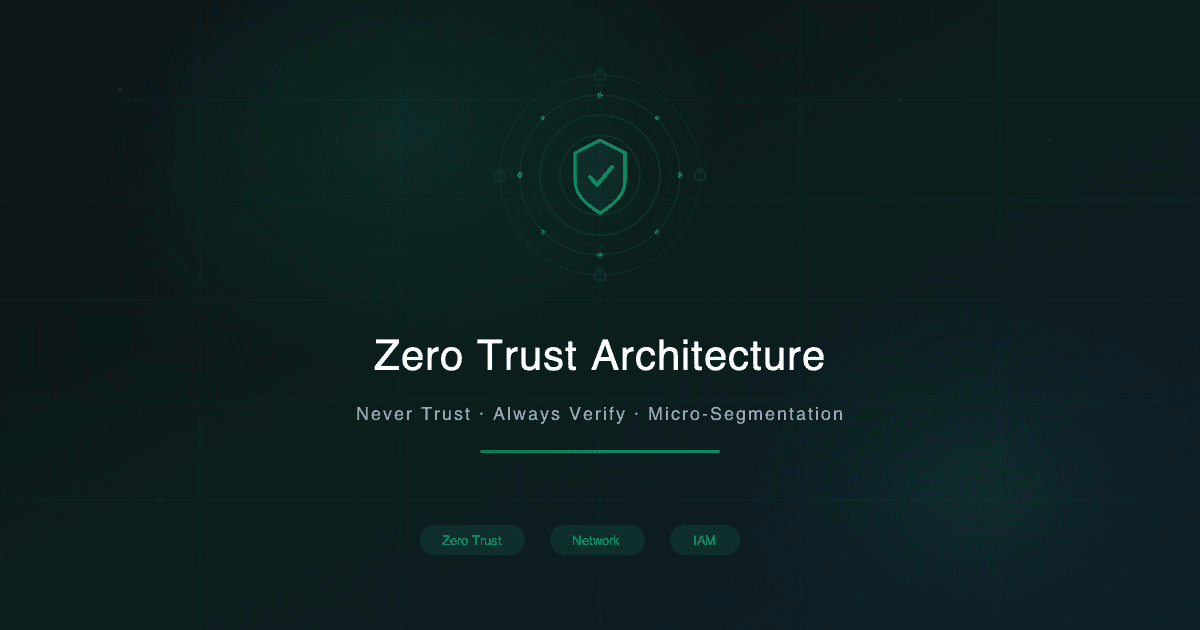
Zero Trust flips the model: assume the network is already compromised. Verify every request, every time, regardless of where it comes from.
Core Principles of Zero Trust
The NIST SP 800-207 framework defines Zero Trust through these principles:
1Zero Trust Architecture Principles:
2
31. Verify Explicitly
4   └─ Authenticate and authorize based on all available data points:
5      identity, location, device health, service, data classification,
6      anomalies, and real-time risk assessment
7
82. Use Least Privilege Access
9   └─ Limit user access with:
10      ├─ Just-In-Time (JIT) access
11      ├─ Just-Enough-Access (JEA)
12      ├─ Risk-based adaptive policies
13      └─ Data protection (encryption, segmentation)
14
153. Assume Breach
16   └─ Minimize blast radius and segment access:
17      ├─ Microsegmentation
18      ├─ End-to-end encryption
19      ├─ Continuous monitoring
20      └─ Automated threat detection & response
Traditional vs. Zero Trust Security
| Aspect | Traditional (Perimeter) | Zero Trust |
|---|---|---|
| Trust model | Trust inside, block outside | Never trust, always verify |
| Network access | Full access after VPN | Per-resource access |
| Authentication | Once at login | Continuous verification |
| Authorization | Role-based, static | Context-aware, dynamic |
| Network segmentation | Flat internal network | Microsegmented |
| Lateral movement | Easy once inside | Blocked by default |
| Data protection | Perimeter encryption | End-to-end encryption |
| Monitoring | Perimeter logs | All traffic, all endpoints |
| Remote work | VPN tunnel to office | Direct-to-cloud access |
| Breach assumption | Preventable | Inevitable—minimize impact |
The Zero Trust Architecture Stack
A complete Zero Trust implementation involves multiple layers:
1Zero Trust Architecture Stack:
2
3┌──────────────────────────────────────────┐
4│           Identity & Access              │
5│  ├─ Identity Provider (Azure AD, Okta)   │
6│  ├─ Multi-Factor Authentication (MFA)    │
7│  ├─ Conditional Access Policies          │
8│  └─ Privileged Access Management (PAM)   │
9├──────────────────────────────────────────┤
10│           Device Security                │
11│  ├─ Endpoint Detection & Response (EDR)  │
12│  ├─ Device Compliance Checks             │
13│  ├─ Mobile Device Management (MDM)       │
14│  └─ Device Health Attestation            │
15├──────────────────────────────────────────┤
16│           Network Security               │
17│  ├─ Microsegmentation                    │
18│  ├─ Software-Defined Perimeter (SDP)     │
19│  ├─ DNS Filtering                        │
20│  └─ Encrypted Transport (mTLS)           │
21├──────────────────────────────────────────┤
22│           Application Security           │
23│  ├─ Secure Access Service Edge (SASE)    │
24│  ├─ Cloud Access Security Broker (CASB)  │
25│  ├─ Web Application Firewall (WAF)       │
26│  └─ API Gateway with Auth                │
27├──────────────────────────────────────────┤
28│           Data Security                  │
29│  ├─ Data Loss Prevention (DLP)           │
30│  ├─ Encryption at Rest & in Transit      │
31│  ├─ Data Classification                  │
32│  └─ Rights Management                    │
33├──────────────────────────────────────────┤
34│           Visibility & Analytics         │
35│  ├─ SIEM (Security Information & Events) │
36│  ├─ UEBA (User & Entity Behavior)        │
37│  ├─ SOAR (Automated Response)            │
38│  └─ Continuous Compliance Monitoring     │
39└──────────────────────────────────────────┘
Google BeyondCorp: Zero Trust Pioneer
Google's BeyondCorp was one of the first large-scale Zero Trust implementations. After the 2009 Operation Aurora attack (attributed to Chinese hackers targeting Google's infrastructure), Google decided to eliminate the concept of a privileged internal network entirely.
BeyondCorp principles:
- Access to services is not determined by network location
- Access is granted based on device state and user credentials
- All access to services must be authenticated, authorized, and encrypted
- Access policies are dynamic and can change based on device state
1BeyondCorp Access Flow:
2
3User Request → Access Proxy → Policy Engine
4                                   │
5                    ┌──────────────┼──────────────┐
6                    │              │              │
7              User Identity   Device Trust   Resource Policy
8              (who are you?)  (is device     (are you allowed
9                              healthy?)      to access this?)
10                    │              │              │
11                    └──────────────┼──────────────┘
12                                   │
13                            Access Decision
14                           ┌───────┴───────┐
15                           │               │
16                        ALLOW           DENY
17                      (with logging)  (with logging)
Every Google employee accesses internal services through this system—no VPN needed. The same model is now available as BeyondCorp Enterprise for other organizations.
Implementing Zero Trust: Practical Steps
Step 1: Identity-Centric Security
Make identity the new perimeter. Every access decision starts with strong authentication:
1# Example: Azure AD Conditional Access Policy
2policy:
3  name: "Require MFA for all cloud apps"
4  conditions:
5    users:
6      include: all_users
7      exclude: break_glass_accounts
8    applications:
9      include: all_cloud_apps
10    locations:
11      include: all_locations
12    device_platforms:
13      include: [android, iOS, windows, macOS, linux]
14    sign_in_risk_levels: [low, medium, high]
15  grant_controls:
16    operator: AND
17    built_in_controls:
18      - mfa
19      - compliant_device
20  session_controls:
21    sign_in_frequency: 12_hours
22    persistent_browser: never
Step 2: Microsegmentation
Break the flat network into isolated segments. Each workload communicates only with explicitly allowed peers:
1# Kubernetes Network Policy — Zero Trust microsegmentation
2apiVersion: networking.k8s.io/v1
3kind: NetworkPolicy
4metadata:
5  name: api-server-policy
6  namespace: production
7spec:
8  podSelector:
9    matchLabels:
10      app: api-server
11  policyTypes:
12    - Ingress
13    - Egress
14  ingress:
15    - from:
16        - podSelector:
17            matchLabels:
18              app: api-gateway
19      ports:
20        - protocol: TCP
21          port: 8080
22  egress:
23    - to:
24        - podSelector:
25            matchLabels:
26              app: postgres
27      ports:
28        - protocol: TCP
29          port: 5432
30    - to:
31        - podSelector:
32            matchLabels:
33              app: redis
34      ports:
35        - protocol: TCP
36          port: 6379
37# Default: deny all other ingress/egress
Step 3: Continuous Verification with mTLS
Every service-to-service communication must be authenticated and encrypted:
1# Mutual TLS (mTLS) verification in Python
2import ssl
3import http.client
4
5def create_mtls_connection(host, port):
6    """Create a connection with mutual TLS authentication."""
7    context = ssl.SSLContext(ssl.PROTOCOL_TLS_CLIENT)
8
9    # Server certificate verification
10    context.load_verify_locations("/etc/ssl/certs/ca-bundle.crt")
11
12    # Client certificate (proves our identity to the server)
13    context.load_cert_chain(
14        certfile="/etc/ssl/certs/client.crt",
15        keyfile="/etc/ssl/private/client.key"
16    )
17
18    context.check_hostname = True
19    context.verify_mode = ssl.CERT_REQUIRED
20
21    conn = http.client.HTTPSConnection(host, port, context=context)
22    return conn
23
24# Both client and server verify each other's identity
25conn = create_mtls_connection("api.internal.example.com", 443)
26conn.request("GET", "/api/v1/data")
27response = conn.getresponse()
SASE: Zero Trust for the Cloud Era
Secure Access Service Edge (SASE) combines networking and security into a single cloud-delivered service. It's the network architecture that makes Zero Trust practical for distributed organizations:
| SASE Component | Function | Replaces |
|---|---|---|
| SD-WAN | Intelligent traffic routing | Traditional WAN/MPLS |
| SWG (Secure Web Gateway) | Web filtering, malware scanning | On-prem proxy appliances |
| CASB | Cloud app visibility & control | Shadow IT audits |
| ZTNA (Zero Trust Network Access) | Per-app access without VPN | Traditional VPN |
| FWaaS (Firewall as a Service) | Cloud-delivered firewall | Hardware firewalls |
Major vendors: Zscaler, Cloudflare One, Palo Alto Prisma, Netskope.
Maturity Model: Where Are You?
| Level | Description | Characteristics |
|---|---|---|
| Level 0 | Traditional perimeter | Firewall + VPN, flat internal network |
| Level 1 | Identity-aware | MFA deployed, SSO for cloud apps |
| Level 2 | Device-aware | EDR on endpoints, device compliance checks |
| Level 3 | Microsegmented | Network policies per workload, mTLS between services |
| Level 4 | Adaptive | Real-time risk scoring, automated response, full SASE |
| Level 5 | Autonomous | AI-driven policy, self-healing, continuous verification |
Most enterprises in 2024 are between Level 1 and Level 2. Full Level 4+ implementations remain rare outside of tech giants like Google, Microsoft, and Netflix.
Real-World Adoption
- US Government: Executive Order 14028 (May 2021) mandates Zero Trust for all federal agencies by 2024
- Microsoft: Reports 90% of their internal resources are behind Zero Trust controls
- Cloudflare: Replaced their own corporate VPN with Cloudflare Access (ZTNA)
- Financial sector: PCI DSS 4.0 aligns with Zero Trust principles for cardholder data protection
Challenges and Pitfalls
- Complexity: Zero Trust is not a product—it's an architecture. No single vendor covers everything
- Legacy systems: Mainframes and OT (operational technology) systems often can't support modern authentication
- User friction: Continuous verification can frustrate users if poorly implemented
- Cost: Full implementation requires significant investment in identity, EDR, SASE, and SIEM
- Cultural shift: "Trust but verify" → "never trust" requires organizational change management
Getting Started
For organizations beginning their Zero Trust journey:
- Start with identity: Deploy MFA everywhere, implement SSO
- Inventory assets: You can't protect what you don't know exists
- Classify data: Identify crown jewels and protect them first
- Segment the network: Start with critical workloads
- Monitor everything: Deploy SIEM and enable logging across all systems
- Iterate: Zero Trust is a journey, not a destination
The castle-and-moat era is over. In a world of cloud, remote work, and sophisticated threats, Zero Trust isn't optional—it's the minimum viable security architecture.
Sources: NIST SP 800-207, Google BeyondCorp, CISA Zero Trust Maturity Model