When One Update Crashed the World
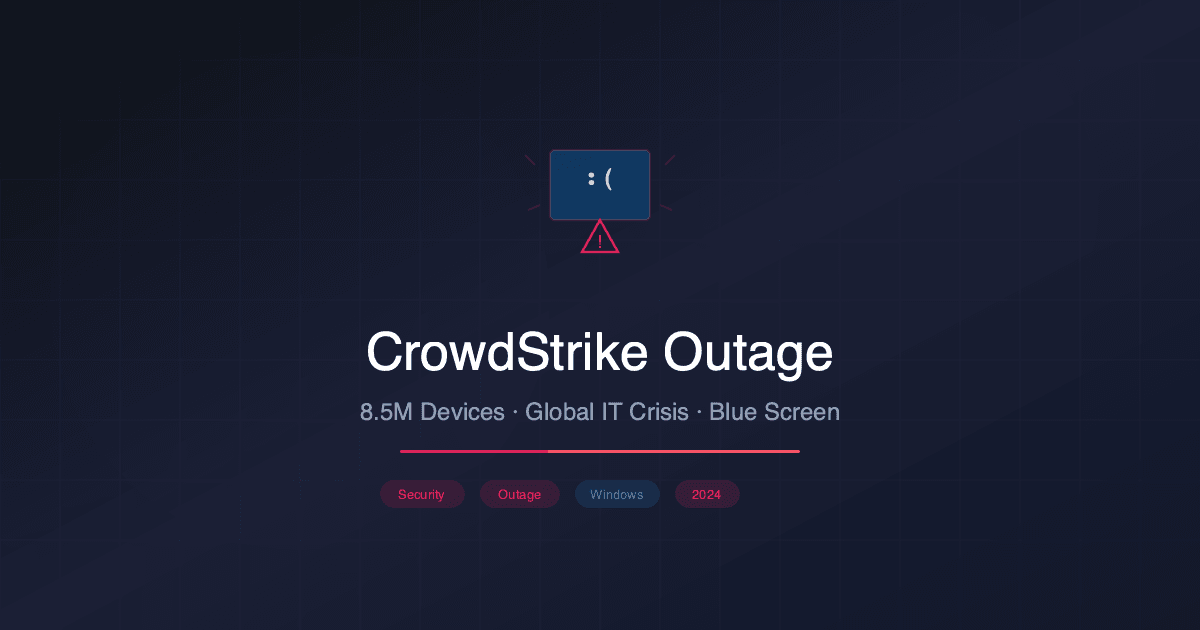
On July 19, 2024, a routine content update from CrowdStrike—one of the world's largest cybersecurity companies—caused the most widespread IT outage in history. An estimated 8.5 million Windows computers crashed simultaneously, displaying the dreaded Blue Screen of Death (BSOD), grounding flights, shutting down hospitals, and paralyzing businesses worldwide.
The incident wasn't a cyberattack. It was a faulty sensor configuration update pushed to CrowdStrike's Falcon endpoint protection agent—a software that runs at the kernel level on Windows machines. The update caused an out-of-bounds memory read, crashing the Windows kernel instantly.
Timeline of the Outage
| Time (UTC) | Event |
|---|---|
| 04:09 | CrowdStrike pushes Channel File 291 update |
| 04:09-04:15 | Affected machines begin crashing worldwide |
| 04:30 | Reports of mass BSOD incidents on social media |
| 05:27 | CrowdStrike identifies the issue and reverts the update |
| 06:00 | Fix available but requires manual intervention per machine |
| ~06:00-07:00 | Airlines begin grounding flights |
| 08:00 | CrowdStrike CEO confirms "not a security incident" |
| 12:00+ | Recovery begins (manual, machine-by-machine) |
| Days-Weeks | Full recovery takes 1-2 weeks for large organizations |
Technical Root Cause
The fault was in a Channel File update—a configuration file (not code) that tells the Falcon sensor how to detect threats:
1CrowdStrike Falcon Architecture:
2┌─────────────────────────────────┐
3│ Windows Kernel Space            │
4│ ├── Windows OS Kernel           │
5│ ├── Hardware Drivers            │
6│ └── CrowdStrike Falcon Sensor  │ ← Runs in kernel mode
7│     ├── csagent.sys (driver)    │
8│     └── Channel Files (config)  │ ← Updated file
9│         └── C-00000291-*.sys    │ ← THE faulty file
10└─────────────────────────────────┘
What happened:
- Channel File 291 contained a new threat detection template
- The template referenced a memory field that didn't exist
- When the sensor tried to read this field → out-of-bounds memory access
- Since the sensor runs in kernel mode → instant kernel panic (BSOD)
- On reboot → sensor loads → reads the same file → crashes again (boot loop)
The boot loop was the catastrophic element. Affected machines couldn't start Windows because the Falcon sensor loaded during boot, read the faulty file, and crashed before the OS fully started.
The Manual Fix
Recovery required physical access to each affected machine:
1# Recovery steps (per machine):
2# 1. Boot into Windows Safe Mode or Recovery Mode
3# 2. Navigate to CrowdStrike directory
4# 3. Delete the faulty channel file
5
6# For standard machines:
7# Boot to Safe Mode → Delete:
8C:\Windows\System32\drivers\CrowdStrike\C-00000291*.sys
9
10# For BitLocker-encrypted machines (most enterprise):
11# 1. Get BitLocker recovery key from Active Directory
12# 2. Enter recovery key to unlock drive
13# 3. Navigate and delete the file
14# 4. Reboot
15
16# For cloud VMs (AWS, Azure, GCP):
17# 1. Detach boot volume
18# 2. Attach to recovery instance
19# 3. Mount and delete the file
20# 4. Reattach and reboot
The BitLocker problem: Most enterprise machines use BitLocker encryption. In Safe Mode, you need the recovery key to access the drive. Many organizations stored these keys in Active Directory or Intune—which were also down because they ran on affected machines. This created a chicken-and-egg problem that significantly delayed recovery.
Global Impact
By the numbers:
- 8.5 million Windows machines affected
- 5,000+ flights canceled (Delta, United, American Airlines)
- Hospitals in multiple countries canceled surgeries
- Banks couldn't process transactions
- 911 systems went offline in several US states
- Broadcasting disrupted (Sky News UK went off air)
- Estimated cost: $5-10 billion globally
Sector-by-sector impact:
| Sector | Impact | Recovery Time |
|---|---|---|
| Airlines | 5,000+ flights canceled | 3-5 days |
| Healthcare | Surgeries canceled, ER manual mode | 1-3 days |
| Banking | Transaction processing halted | 1-2 days |
| Government | 911, DMV, courts offline | 1-3 days |
| Retail | POS systems, supply chain | 1-2 days |
| Media | Broadcast interruptions | Hours |
Why Was the Impact So Massive?
Several factors amplified the outage:
1. Kernel-level access: Falcon runs in kernel mode for security monitoring. This means a bug crashes the entire OS, not just the application.
2. Automatic updates: Channel files update automatically without admin approval. This is by design—security updates need rapid deployment—but it means untested updates can hit millions of machines simultaneously.
3. Monoculture risk: CrowdStrike protects ~60% of Fortune 500 companies. When a single vendor with this market share has a failure, the blast radius is enormous.
4. Boot-time loading: The sensor loads during boot, before Windows is fully running. This makes recovery impossible without manual intervention.
Lessons for the Industry
For software vendors:
- Staged rollouts are essential, even for configuration updates
- Kernel-mode software needs extra testing safeguards
- Recovery mechanisms must exist for boot-time failures
- Single points of failure at this scale are unacceptable
For enterprises:
- Vendor diversity reduces monoculture risk
- BitLocker recovery key accessibility needs planning
- Incident response plans should account for simultaneous global failures
- Manual recovery procedures must be documented and practiced
For developers:
- Memory safety matters (Rust, bounds checking)
- Configuration changes can be as dangerous as code changes
- Testing in kernel mode requires different approaches than userspace
Regulatory and Legal Aftermath
- Congressional hearings: CrowdStrike CEO testified before Congress
- Lawsuits: Delta Airlines sued CrowdStrike for $500M+ in damages
- Insurance claims: Billions in business interruption claims
- Regulatory scrutiny: EU and US regulators reviewing kernel-access policies
The CrowdStrike outage demonstrated a fundamental fragility in global IT infrastructure: the world's most critical systems depend on a handful of software vendors operating at the kernel level, with update mechanisms designed for speed rather than safety.
Sources: CrowdStrike Post-Incident Report, Microsoft Blog, Reuters