The Most Complex Tech-Policy Crisis
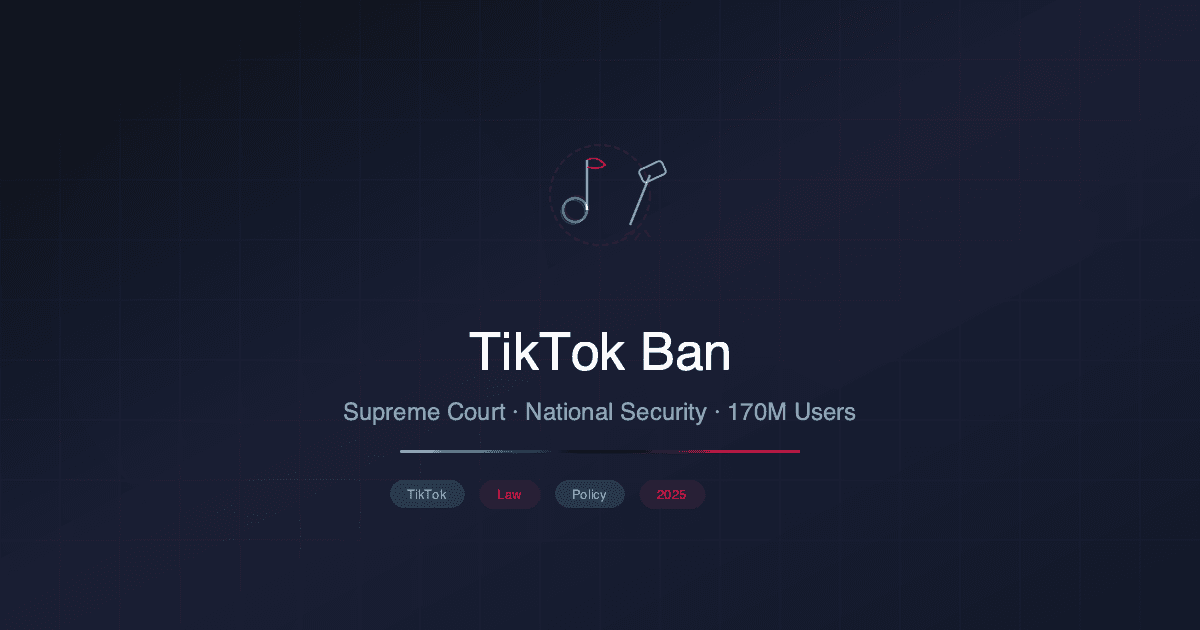
The TikTok saga in the United States represents one of the most complex intersections of technology, national security, and free speech in modern history. On January 17, 2025, the Supreme Court unanimously upheld the "Protecting Americans from Foreign Adversary Controlled Applications Act," setting the stage for either a ban or forced divestiture of TikTok's US operations.
Timeline of the TikTok Crisis
| Date | Event |
|---|---|
| Aug 2020 | Trump executive order to ban TikTok |
| Sep 2020 | Oracle/Walmart deal proposed; blocked by courts |
| Mar 2023 | TikTok CEO testifies before Congress |
| Apr 2024 | Congress passes divestiture bill (360-58) |
| Dec 2024 | DC Circuit upholds the law |
| Jan 17, 2025 | Supreme Court rules 9-0 to uphold |
| Jan 18, 2025 | TikTok briefly goes dark in US |
| Jan 20, 2025 | Trump signs executive order granting 75-day extension |
The National Security Argument
The government's case rested on several key concerns about ByteDance's ownership:
Data Collection: TikTok collects extensive user data—location, browsing patterns, biometric data, device information, and behavioral profiles. With 170 million US users, this represents one of the largest datasets on American citizens held by a Chinese-owned company.
Algorithmic Influence: The recommendation algorithm—TikTok's core competitive advantage—is controlled by ByteDance. Concerns include potential content manipulation for propaganda purposes, selective suppression of content critical of China, and amplification of divisive content during elections.
Legal Framework in China: China's National Intelligence Law (2017) requires organizations to "support, assist, and cooperate with national intelligence efforts." This creates a legal obligation for ByteDance to comply with Chinese government data requests, regardless of where the data is stored.
The First Amendment Debate
TikTok and its supporters argued the ban violated free speech:
- 170 million users rely on TikTok for expression, news, and commerce
- 5 million businesses use the platform for marketing and sales
- Content creators (many earning their primary income) face displacement
- Less restrictive alternatives exist (data localization, oversight boards)
The Supreme Court's response was nuanced: while acknowledging the First Amendment implications, the Court found that national security concerns justified the restriction when the law targeted foreign government control, not speech content.
Technical Reality of "Project Texas"
TikTok invested $1.5 billion in "Project Texas"—an initiative to store US user data on Oracle's servers and create American-controlled access gates. However, critics pointed out:
1Project Texas Architecture (as proposed):
2┌─────────────────────────────────────┐
3│ US User Data (Oracle Cloud)         │
4│ ├── User profiles                   │
5│ ├── Content metadata                │
6│ └── Recommendation signals          │
7│     ↓ (filtered access)             │
8│ Oracle Gateway (US-controlled)      │
9│     ↓                               │
10│ ByteDance Engineers (limited access) │
11└─────────────────────────────────────┘
12
13Key concern: Algorithm source code and model
14weights still maintained by ByteDance in China
The fundamental issue remained: even with US-hosted data, ByteDance controls the algorithm. The recommendation system—which determines what 170 million Americans see—runs on ByteDance-maintained code.
Economic Impact
TikTok's US operations represent significant economic activity:
- $11 billion in estimated US ad revenue (2024)
- 7,000+ US employees
- TikTok Shop processed billions in transactions
- Creator economy: Thousands of full-time creators depend on the platform
- Small businesses: Many built their entire marketing strategy around TikTok
Global Precedent
The US decision creates precedent for how democracies handle foreign-owned technology platforms. Other nations watching closely:
- EU: Investigating TikTok under Digital Services Act
- India: Banned TikTok in 2020 (still banned)
- Australia, Canada, UK: Banned TikTok from government devices
- Taiwan: Considering restrictions for national security
What Happens Next
As of early 2025, the situation remains fluid:
- 75-day extension from Trump's executive order (expires mid-April 2025)
- Potential buyers: Oracle, Microsoft, and a consortium involving US investors
- ByteDance's position: Has consistently refused to sell the US operations
- Algorithm question: Any sale would need to include the recommendation algorithm—something ByteDance (and likely China's government) would resist
The TikTok case establishes that digital platforms with foreign government ties face constitutional scrutiny that balances free expression against national security—a framework that will shape tech policy for decades.
Sources: Supreme Court Opinion, Congress.gov - HR 7521, Reuters TikTok Coverage
Lessons for the Tech Industry
The TikTok saga offers crucial lessons:
- Platform dependency is risk: Millions of creators built businesses on a platform facing existential threat
- Data sovereignty matters: Where data is stored and who controls it has geopolitical implications
- Algorithm transparency: The debate highlighted how little we understand about content recommendation systems
- Regulatory preparedness: Tech companies must plan for regulatory scenarios across jurisdictions
- Diversification: Both users and businesses should maintain presence across multiple platforms
The TikTok case will be studied in law schools, business schools, and policy institutes for decades as the defining example of technology regulation in the age of global platforms.
Sources: Supreme Court, Congress.gov, Reuters Tech