AI Wins the Nobel Prize
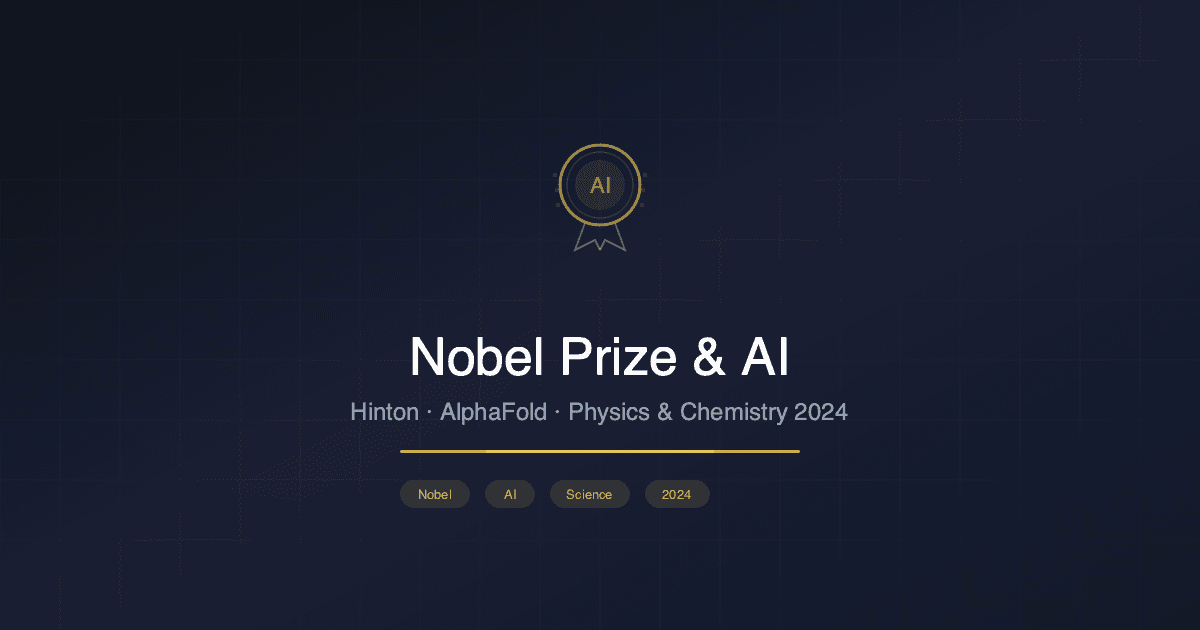
In October 2024, the Nobel Committee awarded two of its most prestigious prizes to AI researchers—marking the moment artificial intelligence research entered the pantheon of humanity's greatest scientific achievements.
Physics Prize: Geoffrey Hinton and John Hopfield received the Nobel Prize in Physics for "foundational discoveries and inventions that enable machine learning with artificial neural networks." Hinton, often called the "Godfather of AI," developed backpropagation and deep learning techniques that power virtually every modern AI system.
Chemistry Prize: Demis Hassabis and John Jumper of Google DeepMind, along with David Baker, received the Nobel Prize in Chemistry for computational protein design and protein structure prediction—specifically for AlphaFold, which solved a 50-year grand challenge in biology.
Geoffrey Hinton: From Backpropagation to Nobel
Geoffrey Hinton's contributions to AI span four decades:
| Year | Contribution | Impact |
|---|---|---|
| 1986 | Backpropagation | Enabled training of multi-layer neural networks |
| 2006 | Deep Belief Networks | Revived interest in deep learning |
| 2012 | AlexNet (ImageNet) | Proved deep learning works at scale |
| 2014 | Dropout regularization | Prevented overfitting in deep networks |
| 2017 | Capsule Networks | Novel approach to spatial hierarchies |
The Nobel Committee specifically cited Hinton's work on Boltzmann machines and the development of training methods that made deep learning practical. His 2012 AlexNet paper (with students Alex Krizhevsky and Ilya Sutskever) triggered the modern deep learning revolution—every GPT, DALL-E, and self-driving car traces its lineage to this work.
1# The core of Hinton's contribution: backpropagation
2# This simple algorithm enables training of deep neural networks
3
4def backpropagation(network, input_data, target, learning_rate=0.01):
5    # Forward pass: compute predictions
6    activations = forward_pass(network, input_data)
7
8    # Compute loss (difference between prediction and target)
9    loss = compute_loss(activations[-1], target)
10
11    # Backward pass: compute gradients layer by layer
12    gradients = []
13    for layer in reversed(network.layers):
14        gradient = compute_gradient(layer, loss)
15        gradients.append(gradient)
16
17    # Update weights: move in direction that reduces loss
18    for layer, grad in zip(network.layers, reversed(gradients)):
19        layer.weights -= learning_rate * grad
20
21    return loss
AlphaFold: Solving Protein Folding
Demis Hassabis and John Jumper's AlphaFold solved one of biology's greatest challenges: predicting a protein's 3D structure from its amino acid sequence.
Why protein folding matters:
- Proteins are the "machines" of life—they perform nearly every function in cells
- A protein's function depends on its 3D shape
- Determining shape experimentally takes months to years and costs millions
- AlphaFold predicts structure in minutes with near-experimental accuracy
AlphaFold's impact by numbers:
| Metric | Value |
|---|---|
| Proteins predicted | 200+ million (nearly all known) |
| Research papers citing AlphaFold | 20,000+ |
| Time to predict one structure | Minutes (vs. months/years) |
| Accuracy (GDT score) | 92.4 (experimental: ~90) |
| Cost per prediction | ~$0.10 (vs. $100,000+ experimental) |
1# Using AlphaFold predictions via API
2from alphafold import AlphaFoldDB
3
4# Get predicted structure for any protein
5structure = AlphaFoldDB.get_prediction("P12345")
6print(f"Confidence: {structure.plddt_score}")
7print(f"Structure: {structure.pdb_file}")
8
9# AlphaFold has predicted structures for:
10# - 214 million proteins
11# - Covering virtually all known organisms
12# - Available free at alphafold.ebi.ac.uk
David Baker: Designing New Proteins
David Baker's contribution was the inverse problem: instead of predicting how natural proteins fold, he designed entirely new proteins that don't exist in nature. His software, Rosetta, enables:
- Custom enzymes: Proteins that catalyze specific chemical reactions
- Drug design: Proteins that bind to disease targets
- Materials science: Protein-based materials with novel properties
- Biosensors: Proteins that detect specific molecules
The Physics Nobel Controversy
Hinton's Nobel in Physics (not a new category) sparked debate:
Arguments for:
- Neural networks are inspired by physical systems (Boltzmann machines)
- The mathematical framework uses statistical mechanics
- Hopfield networks are directly analogous to physical systems
Arguments against:
- Machine learning is computer science, not physics
- No new physical laws were discovered
- Sets a precedent for awarding physics prizes to engineers
The Nobel Committee's decision signals that physics increasingly encompasses computational and information-theoretic work—a recognition that AI's mathematical foundations are as fundamental as particle physics.
The "Godfather of AI" Warning
Ironically, Hinton left Google in 2023 specifically to warn about AI dangers. In his Nobel acceptance speech, he emphasized:
"These things will get smarter than us and could be dangerous. We need to figure out how to maintain control."
This makes Hinton perhaps the only Nobel laureate who is actively campaigning against the unchecked advancement of the field that earned him the prize.
Impact on AI Research
The Nobel prizes validate AI as fundamental science, not just engineering:
- Funding: Expect increased government funding for AI research
- Talent: Top physics/chemistry students may pivot to AI
- Recognition: AI research gains prestige in traditional scientific circles
- Ethics: Hinton's warnings gain authority from the Nobel platform
- Interdisciplinary: AI + science collaboration becomes the default
For the tech industry, these prizes confirm that AI's most transformative applications may be in science—drug discovery, materials design, climate modeling—rather than chatbots and image generation.
Sources: Nobel Prize Physics 2024, Nobel Prize Chemistry 2024, AlphaFold, DeepMind Blog