AI Takes Over Consumer Electronics
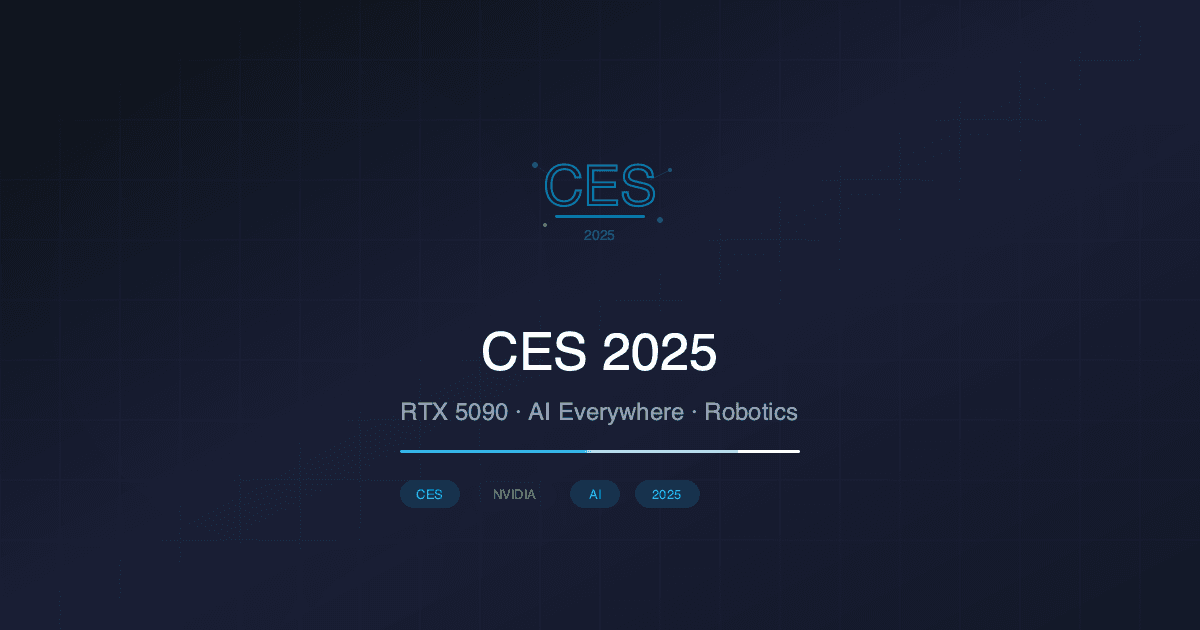
CES 2025 (January 7-10, Las Vegas) was dominated by a single theme: artificial intelligence in everything. From refrigerators to robots to cars, every major manufacturer showcased AI-powered products. The show marked the transition of AI from a tech industry buzzword to a consumer electronics feature—present in products people actually buy.
NVIDIA's Keynote: Personal AI Computing
Jensen Huang's CES keynote set the tone with two major consumer announcements:
GeForce RTX 5090/5080 (Blackwell for consumers):
| Specification | RTX 5090 | RTX 5080 | RTX 4090 |
|---|---|---|---|
| CUDA Cores | 21,760 | 10,752 | 16,384 |
| VRAM | 32 GB GDDR7 | 16 GB GDDR7 | 24 GB GDDR6X |
| AI TOPS | 3,352 | 1,801 | 1,321 |
| DLSS 4 | Multi Frame Gen | Multi Frame Gen | Frame Gen (v3) |
| Price | $1,999 | $999 | $1,599 |
| Release | Jan 30 | Jan 30 | Oct 2022 |
DLSS 4 Multi Frame Generation is the headline feature: AI generates up to 3 additional frames for every rendered frame, potentially 4x frame rate improvements. Combined with path tracing, this enables cinematic-quality real-time graphics.
Project DIGITS: A personal AI supercomputer ($3,000) with:
- Grace Blackwell chip (1 PFLOPS AI performance)
- 128 GB unified memory
- Runs 200B parameter models locally
- Linux desktop form factor
Samsung: AI in Every Screen
Samsung's "AI for All" strategy puts intelligence in every product:
- Galaxy S25 series: On-device AI with Snapdragon 8 Elite, Google Gemini integration
- AI TVs: Content upscaling, generative wallpapers, ambient intelligence
- Bespoke AI appliances: Refrigerators that track food, suggest recipes, manage grocery lists
- Vision AI: Cameras that recognize objects, people, pets and automate responses
1Samsung AI Home Ecosystem:
2┌─────────────────────────────────┐
3│ SmartThings Hub (AI Brain)      │
4├─────────────────────────────────┤
5│ Inputs:                         │
6│ ├── Door/window sensors         │
7│ ├── Camera feeds                │
8│ ├── Appliance status            │
9│ └── User behavior patterns      │
10│                                 │
11│ AI Processing:                  │
12│ ├── Recognize routines          │
13│ ├── Predict preferences         │
14│ ├── Optimize energy             │
15│ └── Security monitoring         │
16│                                 │
17│ Actions:                        │
18│ ├── Adjust thermostat           │
19│ ├── Control lighting            │
20│ ├── Start appliances            │
21│ └── Send alerts                 │
22└─────────────────────────────────┘
Robotics: The Breakout Category
CES 2025 saw more robot demonstrations than any previous year:
| Company | Robot | Function | Price |
|---|---|---|---|
| Samsung | Ballie | Home companion/projector | TBA |
| LG | Smart Home AI Agent | Home management | TBA |
| Unitree | H1/G1 | Humanoid, warehouse | $16K-90K |
| Boston Dynamics | Spot + AI | Industrial inspection | Lease |
| Roborock | Saros Z70 | Vacuum + arm (picks up objects) | ~$2,000 |
The Roborock Saros Z70 was particularly notable—a robot vacuum with an articulated arm that can pick up small objects (socks, toys) before vacuuming. This is the first practical application of manipulation AI in consumer products.
Automotive AI
Every major automaker showcased AI-powered vehicles:
- Mercedes MBUX: Natural language navigation, personalized driving
- BMW: ChatGPT integration in infotainment
- Hyundai/Kia: Software-defined vehicles with OTA AI updates
- Sony Honda AFEELA: AI-native vehicle with 45 sensors
- Waymo/Zoox: Expanded autonomous taxi services
Health and Wellness AI
| Product | Company | Function |
|---|---|---|
| AI hearing aids | Multiple | Real-time noise cancellation, language translation |
| Smart mirrors | Withings | Health metrics, skin analysis, posture detection |
| Sleep tech | ResMed | AI-optimized CPAP, sleep coaching |
| Smart rings | Samsung Galaxy Ring | 24/7 health monitoring with AI insights |
| Mental health | Various | AI-powered meditation, stress detection |
Key Trends
1. On-Device AI: Processing moves from cloud to device. NVIDIA, Qualcomm, and Intel all pushed local AI processing, citing privacy, latency, and reliability benefits.
2. Ambient Intelligence: Devices that understand context without explicit commands. Samsung's Ballie follows you, projects information on walls, and manages your home proactively.
3. AI as Infrastructure: AI isn't a feature—it's the foundation. Products are designed around AI capabilities rather than adding AI to existing products.
4. The Subscription Problem: Many AI features require monthly subscriptions. A $2,000 refrigerator with a $10/month AI plan raises questions about long-term value.
5. Privacy Tensions: On-device processing addresses privacy concerns, but many products still send data to the cloud for advanced features. The privacy-capability trade-off remains unresolved.
Impact on the Tech Industry
CES 2025 confirmed that AI has moved beyond the "demo" phase into mass consumer products. The key question for 2025 isn't whether AI will be in consumer electronics—it's whether consumers will pay premium prices for AI features and whether the subscription models are sustainable.
For developers, CES signals growing demand for on-device AI models, edge computing optimization, and AI-powered IoT integration. The platforms and tools enabling these products (NVIDIA Jetson, Qualcomm AI Hub, Google Edge TPU) are becoming mainstream development targets.
Sources: CES 2025, NVIDIA CES Keynote, The Verge CES Coverage