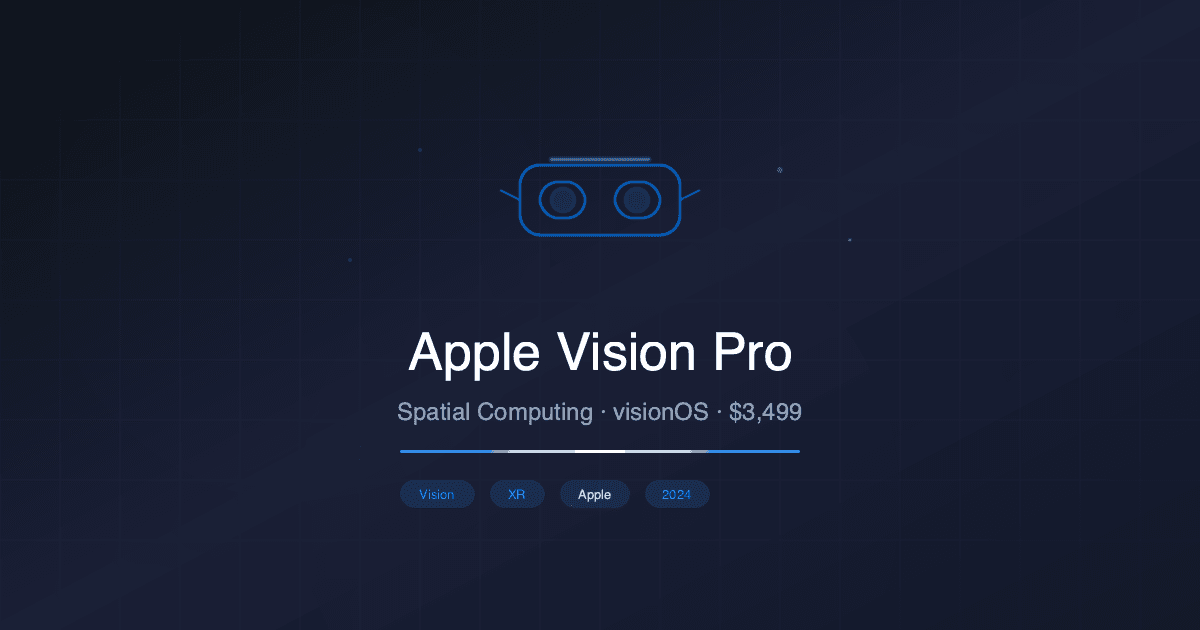
Apple's $3,499 Bet on Spatial Computing
On February 2, 2024, Apple launched Vision Pro—the most ambitious consumer electronics product since the original iPhone. Priced at $3,499, this mixed reality headset represents Apple's vision for the future of computing: a world where digital content seamlessly blends with physical reality, controlled by your eyes, hands, and voice.
Pre-orders opened on January 19, 2024, and sold out within minutes. An estimated 200,000 units were sold during the pre-order period, with delivery estimates stretching to March within the first day.
Hardware: Engineering Marvel
Vision Pro's technical specifications are unprecedented for a consumer device:
| Component | Specification | Context |
|---|---|---|
| Display | Micro-OLED, 23 million pixels | More than a 4K TV per eye |
| Resolution | 3,660 × 3,200 per eye | Highest resolution headset |
| Chip | M2 + R1 dual-chip | M2 for computing, R1 for sensor processing |
| Cameras | 12 cameras, 5 sensors, 6 mics | Full environmental awareness |
| Eye Tracking | IR cameras | Precise gaze input at 90Hz |
| Audio | Spatial Audio, ray-traced | Personalized 3D soundstage |
| Battery | External, 2-2.5 hours | Proprietary cable connection |
| Weight | 600-650g | With Light Seal and headband |
The R1 chip is specifically designed for real-time sensor fusion—processing data from all 12 cameras and sensors with only 12 milliseconds of latency, ensuring digital content feels anchored to the real world.
The Spatial Computing Interface
Vision Pro introduces a new interaction paradigm that eliminates traditional controllers:
1Input Methods:
2├── Eye Tracking → Look at an element to select it
3├── Hand Gestures → Pinch, tap, swipe in the air
4│   ├── Pinch: Select/tap
5│   ├── Pinch & drag: Scroll/move
6│   ├── Two-hand pinch: Zoom/resize
7│   └── Flick: Quick scroll
8├── Voice → Siri + dictation
9└── Virtual Keyboard → Floating keyboard with eye+hand typing
10
11No controllers. No remote. Just you.EyeSight: The external display shows a representation of the wearer's eyes to nearby people, maintaining social connection. When someone approaches, the headset becomes transparent, showing the real world with the person visible.
visionOS: A New Operating System
visionOS is built on the same foundation as iOS/macOS but designed for spatial interaction:
1// SwiftUI for visionOS — spatial window
2import SwiftUI
3
4@main
5struct MyApp: App {
6    var body: some Scene {
7        // Standard window (flat, like iPad)
8        WindowGroup {
9            ContentView()
10        }
11
12        // Volumetric content (3D objects in your space)
13        WindowGroup(id: "globe") {
14            Globe3DView()
15        }
16        .windowStyle(.volumetric)
17
18        // Full immersive experience
19        ImmersiveSpace(id: "solar-system") {
20            SolarSystemView()
21        }
22    }
23}
App ecosystem at launch:
- 1 million+ compatible iPad/iPhone apps (flat windows)
- 600+ native visionOS apps at launch
- Key apps: Disney+, Microsoft Office, Zoom, Safari, Photos
Use Cases and Experience
Productivity:
- Multiple virtual displays arranged in your physical space
- Mac Virtual Display: Mirror your Mac as a massive floating screen
- Keynote, Pages, Numbers in spatial mode
Entertainment:
- 3D movies and spatial video playback
- Apple TV+ content in a virtual theater
- Immersive environments (Mount Hood, Moon surface)
Communication:
- Personas: Digital avatar of your face for FaceTime
- SharePlay: Watch movies together in virtual space
- Screen sharing with spatial annotations
Spatial Photos/Video:
- iPhone 15 Pro can capture spatial video
- Vision Pro plays back memories as 3D experiences
- The "killer app" for many early users
Developer Perspective
Building for Vision Pro uses familiar Apple frameworks:
1// Reality Composer Pro + SwiftUI
2struct InteractiveGlobe: View {
3    @State var rotation: Rotation3D = .identity
4
5    var body: some View {
6        RealityView { content in
7            if let globe = try? await ModelEntity(named: "Earth") {
8                globe.components.set(InputTargetComponent())
9                globe.components.set(CollisionComponent(
10                    shapes: [.generateSphere(radius: 0.3)]
11                ))
12                content.add(globe)
13            }
14        }
15        .gesture(
16            DragGesture()
17                .targetedToAnyEntity()
18                .onChanged { value in
19                    // Rotate globe with hand gesture
20                    rotation = value.rotation3D
21                }
22        )
23    }
24}
Market Reception and Challenges
Positives:
- Display quality universally praised ("best screen I've ever looked through")
- Eye/hand tracking accuracy exceeds expectations
- Spatial video is emotionally powerful
- Build quality matches Apple's standards
Challenges:
- Price: $3,499+ puts it beyond most consumers
- Weight: 600g+ causes discomfort after 30-60 minutes
- Battery life: 2-2.5 hours requires external battery
- Isolation: Wearing a headset is socially awkward
- Content: Limited native visionOS content at launch
- Personas: Digital avatars are uncanny valley
Competition and Context
| Device | Price | Resolution | Tracking | Platform |
|---|---|---|---|---|
| Apple Vision Pro | $3,499 | 23M pixels | Eye + Hand | visionOS |
| Meta Quest 3 | $499 | 4.1M pixels | Hand + Controller | Android |
| Meta Quest Pro | $999 | 3.7M pixels | Eye + Hand | Android |
| PlayStation VR2 | $549 | 4M pixels | Eye + Controller | PlayStation |
| Bigscreen Beyond | $999 | 5.1M pixels | SteamVR tracking | SteamVR |
Vision Pro is positioned as a premium computing device, not a gaming headset. Its competition isn't Quest 3 at $499—it's a MacBook Pro or iPad Pro as a productivity tool.
Impact on the Industry
Vision Pro's launch signals Apple's belief that spatial computing is the next major computing platform—following desktop → laptop → phone → spatial:
- Developer investment: Thousands of developers building visionOS apps
- Enterprise interest: Medical, education, engineering applications
- Content creation: Spatial video becomes a new media format
- Hardware roadmap: Cheaper versions expected in 2025-2026
- Industry validation: If Apple invests, the category matters
Whether Vision Pro itself succeeds commercially is less important than the ecosystem it creates. Apple is planting seeds for a future where spatial computing is as natural as touching a glass screen.
Sources: Apple Vision Pro, Apple Developer, visionOS Documentation