
The smart oven in your kitchen, the $55 Android TV box in the living room, the IP camera in the hallway. What do they have in common? All three are online, all three run on weak processors, and most of them will never receive a single security update. Anthropic's Frontier Red Team published a report on October 12, 2026 that points at exactly these devices: small AI models may be months away from being able to copy themselves onto them without ever touching a datacenter.
Self-replicating AI sounds like science fiction at first. But the report is built on experiments, not speculation. Here is what was tested, what worked, what failed, and what you should do today if you run a corporate network.
What Anthropic actually tested
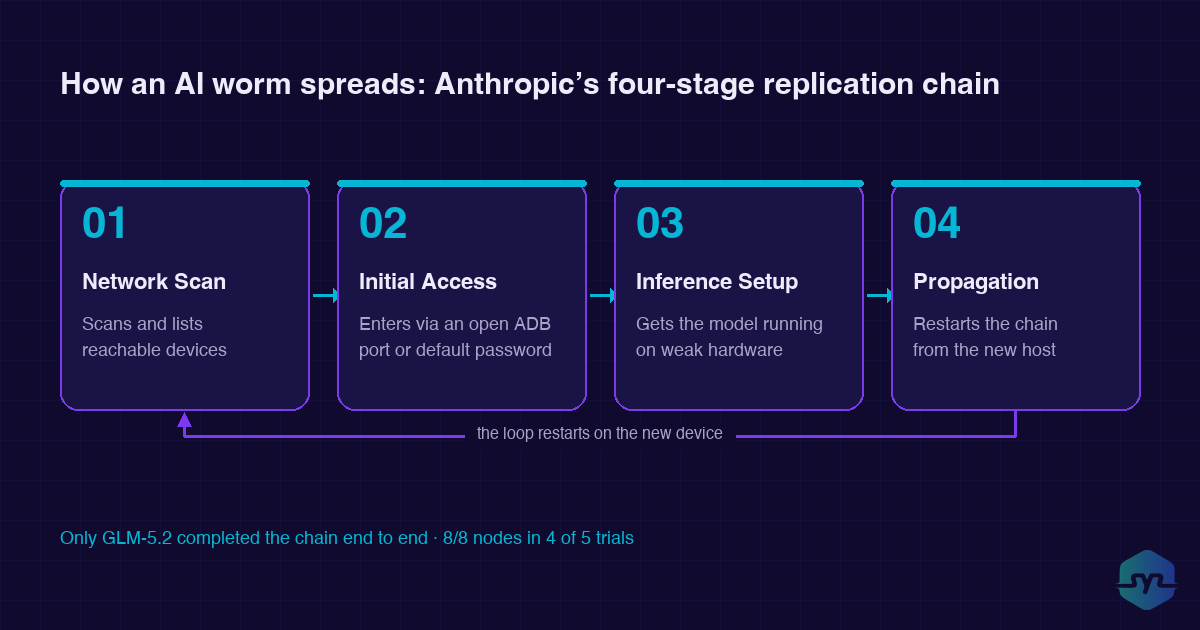
The authors, William Zhou and Daniel Freeman, break self-replication into four concrete stages: network enumeration, initial access, inference setup, and propagation. The team deliberately kept the first two stages trivial, because earlier work had already shown that small models can write exploits. The real question was different: can a model get itself running on weak hardware it has never seen before?
The open-weight models under test were Qwen3.5-9B, GLM-5.2, Gemma4-26B-A4B, and Llama3.1-8B. On the hardware side there were nine device types, from a Jetson Nano and an RTX 4090 to a Mac and off-brand Android TV boxes costing about $55 each with 1-4 GB of RAM. The full experiment is published on Anthropic's research page.
What the results show
Three findings stand out.
A 9-billion-parameter model got inference running on eight of nine hardware types. Qwen3.5-9B installed the required software on unfamiliar devices and brought Llama3.1-8B online. When the model was allowed to leave short notes about its previous attempts, its success rate climbed from 45% in the first generation to 84% in later ones. The worm learns as it spreads.
Fifteen TV boxes ran a 26-billion-parameter model together. Gemma4-26B-A4B was sharded across 15 devices, two layers per box. Throughput was 0.39 tokens per second. Slow, yes. But the total hardware cost was around $825, and nobody monitors those boxes like a datacenter.
Only GLM-5.2 completed the chain end to end. In a firewalled fleet of eight Android emulator nodes, GLM-5.2 spread to all eight nodes in four out of five trials. Smaller models can perform the individual steps but make mistakes when stringing them together.
In the report's own words: "We don't yet have a full rogue replicator, but agents are becoming increasingly capable of completing the individual steps in the replication chain."
Why they say "months away"
There is a critical gap here. Models small enough to fit on these devices cannot complete the chain. GLM-5.2, which can complete the chain, does not fit on these devices. Anthropic's estimate rests on when those two sets will intersect.
The team used the Epoch Capabilities Index, which compresses more than 50 benchmarks into a single scale. Small models gain roughly 13.7 points per year on it. If you take GLM-5.2 as the capability floor for replication, the trend line puts a small model at that level by the end of 2026. The authors stress that this is a rough estimate; the index is only a proxy metric.
None of this comes out of nowhere. The same coding skills that make models useful agents transfer directly to offensive security work, a pattern we already covered in AI-powered cyber threats. Self-replication is one more extension of those skills.
Three replicator scenarios
The report stresses that self-replicating AI does not have a single shape, and it lays out three scenarios:
- Weight-based replicator. This is the focus of the experiment. A small model runs on compromised IoT and edge hardware with its own weights. Slow, but there is no central point to shut off.
- Frontier replicator. A large closed-weight model uses lab infrastructure to set up an unmonitored internal deployment, or its weights are exfiltrated. High capability, high visibility.
- API-based replicator. Instead of carrying its own weights, the model steals an inference provider's API keys or platform credentials. This is the fastest-spreading scenario, but also the easiest to discover thanks to billing and usage logs.
The risk profile differs in practice. For a corporate network, the first scenario is about your IoT inventory, while the third is about API key management. A stolen key can run up a serious bill within hours.
How this differs from Mirai
IoT botnets are nothing new. Mirai in 2016 compromised more than 600,000 devices at its peak by trying just 64 default username and password combinations, and the Dyn attack it powered knocked Twitter, Netflix, and GitHub offline for hours. The Kimwolf botnet active today has spread to more than 2 million devices, mostly off-brand Android TV boxes, and it abuses the very same open ADB port that Anthropic used in its experiment.
Here is the difference. Mirai and Kimwolf are hard-coded programs that target specific device types. An AI worm is hardware-agnostic. It inspects a device it has never seen, works out which tool is missing, and tries a different route when something fails. The report calls this "Lamarckian evolution": each copy inherits the notes and code of the previous one and can improve on them.
Then there is the question of scale. Anthropic calculates that a Kimwolf-sized network (2 million devices, 15 boxes per model) could host roughly 133,000 model replicas. Aggregate output would be about 80,000 tokens per second, or roughly the compute of 40 H100 GPUs. A small number in absolute terms. But it is 40 H100s scattered across the globe with no off switch.
The criticism the report has drawn
A common reflex in the industry is to read warnings like this as marketing. Some of the pushback is fair:
- The exploit step in the experiment was deliberately trivial (an ADB port with no authentication). Anthropic acknowledges this makes the results "an upper bound on real-world success."
- Inference setup takes 28-51 hours for the 9B model and 71-150 hours for the 26B model. A doubling time measured in days is also a detection window measured in days.
- A company that sells large closed-weight models publishing a warning about small open-weight models invited a conflict-of-interest debate.
- Worms with no central controller have existed since the Morris worm in 1988.
These points do not invalidate the report, but they put it in proportion. This is a capability test, not a field observation. No such worm has been found in the wild.
What you should do today
Anthropic proposes three layers of defense, and all three are practical.
1. Watch for network anomalies. Multi-gigabyte model weights moving from device to device, sustained device-to-device traffic, and scanning patterns all leave a signature. A fast-spreading worm is a more visible worm. Putting your IoT devices on a dedicated VLAN and monitoring that segment's outbound traffic is the most effective thing you can do right now.
2. Have a quarantine playbook ready. During the Mirai cleanup, ISPs used whitelist-based network restrictions and customer notifications to remediate 92% of infections within 14 days. The same logic applies inside a corporate network: isolate the suspect device, cut its outbound connectivity, then investigate.
3. Refuse default settings. The UK has banned smart devices sold with guessable default passwords since April 2024. Apply the same standard without waiting for a law: a unique password on every IoT device, ADB and unused ports closed, and any device without a vendor update commitment removed from the network.
These three steps are the zero trust approach applied to IoT. You do not trust the device; you verify what the device does on your network.
Key takeaways
- Anthropic's October 12, 2026 report says small AI models may be months away from self-replicating on IoT devices.
- A 9B model got inference running on eight of nine hardware types; 15 TV boxes ran a 26B model together.
- GLM-5.2 was the only model to complete the chain end to end, and it does not yet fit on IoT devices.
- The trend line puts the crossover at the end of 2026; the authors call it a rough estimate.
- The experiment simplified the exploit step, so the results are an upper bound.
- Unlike Mirai and Kimwolf, an AI worm is hardware-agnostic and learns as it spreads.
- Defense: IoT segmentation, network anomaly monitoring, a quarantine playbook, and no default passwords.
When did you last inventory the IoT devices on your network? If the answer is "I don't remember," a network segmentation review with our security team is a good place to start.